jueves, 6 de junio de 2019

martes, 5 de junio de 2018
Why don´t learn maths or geometry and P.E (physical education) together?
One of the most favourite subject, or even the most one, that the children usually have at school is P.E so, why don´t we take advantage of it?
I think that it would be a great if we use this advantange that the children provide us and teaching geometry or maths using intersting games that the pupils can enjoy a lot.
Teaching it in a transversal way. It means that we can teach twho different subjects like if they were one in both sessios. The physical education and maths teachers can agree with and teach the concepts of both subjects in their lessons at the same time!! Is it cool right?
REMEMBER: THE GAME IS THE BEST TOOL TO LEARN.
Here you have some examples for activities of different cycles of primary education. I hope you like it!
- 1st grade: "Catch the number": each studetn will have a certain color which corresponds a number. The students will move freely until the teacher says a number. In that moment the pupils will have to identify those that have the white chest guard.
- 2nd grade: "Squares and circles": the class will be divided in two groups. One of them will start counting up to 30, when the account ends, they will have to catch to the opposite team. The opposite will have to look in the whole playground figures that represent, if they reach them and touch them they will get a point. Then, they will change the tole and count the points that each group has achieved.
- 3rd grade: "Shape figures!" : the class will be divided in groups of the same number of the students approximately. Beginign to move through the space, after a shor period of time the teacher will say a geometric figure so each group will have to form that figure on the ground, the last one will have a "punishment" which consists in: go aroung the filed or jump 10 minutes in a row with the feets together.

Link: http://publicacionesdidacticas.com/hemeroteca/articulo/071022/articulo-pdf
I think that it would be a great if we use this advantange that the children provide us and teaching geometry or maths using intersting games that the pupils can enjoy a lot.
Teaching it in a transversal way. It means that we can teach twho different subjects like if they were one in both sessios. The physical education and maths teachers can agree with and teach the concepts of both subjects in their lessons at the same time!! Is it cool right?
REMEMBER: THE GAME IS THE BEST TOOL TO LEARN.
Here you have some examples for activities of different cycles of primary education. I hope you like it!
- 1st grade: "Catch the number": each studetn will have a certain color which corresponds a number. The students will move freely until the teacher says a number. In that moment the pupils will have to identify those that have the white chest guard.
- 2nd grade: "Squares and circles": the class will be divided in two groups. One of them will start counting up to 30, when the account ends, they will have to catch to the opposite team. The opposite will have to look in the whole playground figures that represent, if they reach them and touch them they will get a point. Then, they will change the tole and count the points that each group has achieved.
- 3rd grade: "Shape figures!" : the class will be divided in groups of the same number of the students approximately. Beginign to move through the space, after a shor period of time the teacher will say a geometric figure so each group will have to form that figure on the ground, the last one will have a "punishment" which consists in: go aroung the filed or jump 10 minutes in a row with the feets together.
Link: http://publicacionesdidacticas.com/hemeroteca/articulo/071022/articulo-pdf
viernes, 25 de mayo de 2018
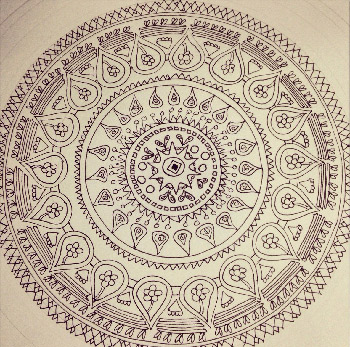
The mandalas, a good strategie to relax and to revise geometric figures!
The mandal has its origin in India, its name means "circle or wheel", passing to represent its basic characteristics, although they can be different forms incorporating all the geometric figures.
Drawing or painting is a therapy that is being used more and more every day. Its desing free and its meaning will depend on its shape and colors.
Meaning of the colors:
- Green: nature
- Pink: love
- Yellow: happiness
- Blue: water
- Red: Passion
- Orange: value
- Purple: wisdom
- Black: sadness
- White: purification
It is also an interesting technique to know how a child is feeling in that moment while s/he is painting with some colors. So, an interesting activity could be make the students create a mandala according to how they feel that day. For the teacher would be really useful to know the students´ feelings and help them when they need. Moreover they also practise the geometric figures!!! What do you think about it?
Let´s go to learn the angles singing!!
As I mentioned in one of my first posts, one of the best way to teach from my personal point of view is singing!!! I think that children love it and the corporal expression is one of the skill that the students have to develop. So, what better way than develop that skills by learning geometry at the same time?
I consider that the angles is a concept that the students learn better if the teaching is visual, but it is time to change the visual method not only with pictures and, from my personal experience, the kids learn so good by songs, why don´t you try it?
Here´s some examples really interesting that you can use for your children!! I hope you enjoy!
Videos in spanish:
This one is so interesting, because it is not a song but it lets to the students think and revise the angles differently. I think that it would be a good tool in order to evaluate the children to replace the traditional exam. What do you think?
Videos in english:
miércoles, 23 de mayo de 2018
Geometric mock-ups about the city!
As I said in previous spots, the geometry is part of our lives and sorrounds us everyday. Everything has a geometric figures so, a good activity to do in class or at home with the children is creating a mock-up about the city. As you know, the cities are composed by a lot of geometric figures. What do you think about it?
Moreover, we can do it in a transversal way, making the mock-up in the art sessions too. The idea is making in groups and let that every child shows his or her creativity and imagination.
Here you are some examples of mock-ups of the city. They look amazing!!! I love this idea and what about you? I hope you like it!
Moreover, we can do it in a transversal way, making the mock-up in the art sessions too. The idea is making in groups and let that every child shows his or her creativity and imagination.
Here you are some examples of mock-ups of the city. They look amazing!!! I love this idea and what about you? I hope you like it!
lunes, 21 de mayo de 2018
The geoplane, a fantastic resource to practise geometry!
It is a fantastic resource to learn maths in a manipulative way!!!
The geoplane was created by Caleb Gattegno in 1960, who looked for a method to teach geometry in a more didactic way. Currently the most of the geoplanes are made of plastic but the origina one consists of an wood square board with nails that towered out and you could hook elastic bands that were used to represent different geometric figures.

Calleb Galetano

A geoplane made of wood
There are three types of geoplane:
1. ORTHOMETRIC:
A cuadricular weave of 25points the most of the times.

2. CIRCULAR:
A colection of points of a circunference that have the same distance of space. It lets making regular polygons of 3, 4, 5, 6, 8, 12 and 24 sides. The last one is the most frequent.

3. ISOMETRIC:
A triangular weave. The points are located in the vertexs of the equilateral triangles.
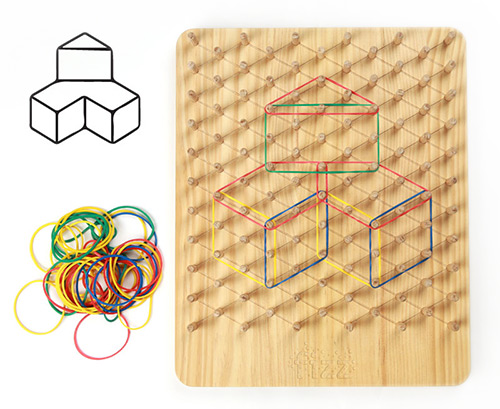
So, to conclude, you can teach this manipulative resources not just to create figures, you can also teach it to study the propierties of an circunference for instance or to solve problems. I think that it is really interesting and it is a way to learn differently.
Here you have some video that show how you can create a geoplane in different ways, I hope you like them!!
The geoplane was created by Caleb Gattegno in 1960, who looked for a method to teach geometry in a more didactic way. Currently the most of the geoplanes are made of plastic but the origina one consists of an wood square board with nails that towered out and you could hook elastic bands that were used to represent different geometric figures.
Calleb Galetano
A geoplane made of wood
There are three types of geoplane:
1. ORTHOMETRIC:
A cuadricular weave of 25points the most of the times.
2. CIRCULAR:
A colection of points of a circunference that have the same distance of space. It lets making regular polygons of 3, 4, 5, 6, 8, 12 and 24 sides. The last one is the most frequent.
3. ISOMETRIC:
A triangular weave. The points are located in the vertexs of the equilateral triangles.
So, to conclude, you can teach this manipulative resources not just to create figures, you can also teach it to study the propierties of an circunference for instance or to solve problems. I think that it is really interesting and it is a way to learn differently.
lunes, 14 de mayo de 2018
Who´s who in mathematics!!
Thinking about the flat figures in class, today my group and I thought about an interesting activity that could be really fun for the students!!
Have you ever played the famous game who´s who?
If you have never played it, here you have a link which shows you the rules of the game: http://www.boardgamecapital.com/guess-who-rules.htm
Now, regarding to the theme of maths that we pretend to teach (the flat figures), we are going to teach it playing in this way:
The students can divide in pairs or in groups. One of the student put in his/her forehead a stick with a flat figure drawn and the other student have to describe the flat figure, that s/he is seeing in that moment, with the objective of his or her classmate guesses the flat figure described.
As I said in other spots before, the best way to teach is motivating to the kids, and I consider that this game it is perfect to learn and revise any concept of maths (the flat figures in this case) and you can even use it in any subject aswell!!
So, what do you think about it? I hope you like the idea and you find it useful for your lessons!!

Have you ever played the famous game who´s who?
If you have never played it, here you have a link which shows you the rules of the game: http://www.boardgamecapital.com/guess-who-rules.htm
Now, regarding to the theme of maths that we pretend to teach (the flat figures), we are going to teach it playing in this way:
The students can divide in pairs or in groups. One of the student put in his/her forehead a stick with a flat figure drawn and the other student have to describe the flat figure, that s/he is seeing in that moment, with the objective of his or her classmate guesses the flat figure described.
As I said in other spots before, the best way to teach is motivating to the kids, and I consider that this game it is perfect to learn and revise any concept of maths (the flat figures in this case) and you can even use it in any subject aswell!!
So, what do you think about it? I hope you like the idea and you find it useful for your lessons!!
Suscribirse a:
Comentarios (Atom)